Kenichi
Awakening the Angel System: Apocalypse: A LitRPG Progression FantasyKenichi is the blind leader of Hoshido and one of the book’s most important figures of communal responsibility. His blindness does not diminish his authority or battlefield effectiveness: he races through a palace by following voices and sound, keeps a katana at his side, recognizes danger through instinct, and later fights beside Tenno beneath an energy dome while the world around them becomes a field of corpses. His arc moves from local leadership and inherited grievance toward a difficult political stewardship, culminating in his place on the council governing the Frontier after the world’s magical order collapses.
Identity and Hoshido Leadership
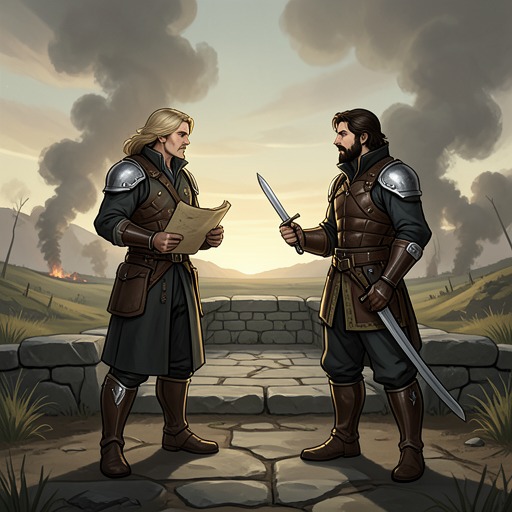
Kenichi is identified through his role as Hoshido’s leader rather than through a private biography alone. When he arrives at the palace with samurai and palace guards, he is described as blindfolded, yet he moves urgently through the halls to reach Ada and Ho-sook. His authority is therefore embodied in both command and action: others call for him, guide him toward the crisis, and depend on him to protect the injured women and children. The same scene places him in immediate tension with Ivan, whose hand rests on a revolver while Kenichi’s hand settles on the katana at his side. Kenichi asks whether he knows Ivan, and the question carries the weight of an older conflict that Ivan fears being recognized.
Hoshido is also presented as a community with material foundations, not merely a name attached to Kenichi. Reports shown to Jack describe roads under construction, a developing wall, and a route toward the main imperial border through Victoria’s crossing. The reports include photographs of Mo Ye, Granny Cao, Ming, and Kenichi holding hands with Valentine near the lakeside. Kenichi’s leadership thus connects domestic life, infrastructure, political borders, and the personal networks that make a settlement feel inhabited. Hoshido’s progress gives Jack visible evidence that the community he left behind is becoming safer and more organized.
Alliances, Trust, and Inherited Conflict
Kenichi’s relationship with Jack is part of a wider network of alliances that repeatedly places old mistrust beside practical cooperation. Tenno arrives with Kenichi to retrieve Ho-sook and discuss trade terms, making Kenichi’s presence part of an effort to maintain political and economic ties rather than an isolated military visit. Later, Kenichi and Tenno fight together during the palace crisis, with Tenno covering the battle and Kenichi concentrating on the safety of the child and the women. Kenichi’s authority is inseparable from this protective function: even amid a supernatural assault, the immediate objective remains preserving vulnerable lives.
His confrontation with Ivan reveals how memory and violence remain active beneath the alliance structure. Kenichi does not recognize Ivan, while Ivan privately wonders whether Kenichi might somehow identify him despite never having spoken to him or seen him. The danger is not resolved by a declaration or confession. Instead, Ivan and Tenno continue fighting while Kenichi is directed toward Ada, Ho-sook, and the child. The scene allows cooperation to proceed without erasing the possibility of revenge, showing how the story’s political relationships are built through temporary decisions made under pressure.
That tension becomes explicit much later when Tenno tells Kenichi that the man before him killed Kenichi’s father and expresses surprise that Kenichi allowed him to live. Kenichi answers that defeating the man is enough for now. The response neither denies the murder nor claims forgiveness. It establishes a controlled postponement of vengeance: Kenichi has asserted his strength, but he refuses to let inherited blood-debt determine the entire present. His restraint is therefore not passivity; it is a decision to leave the conflict unresolved while preserving the possibility of a broader purpose.
Stewardship During the Apocalypse
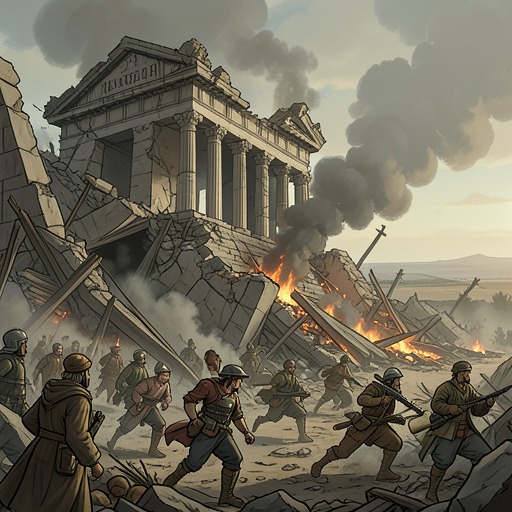
After the Apostle invasion turns Lunacrypt Capital into a wasteland of corpses, demonspawn, and abandoned debris, Selfia relocates her base of operations. Kenichi is present at the new headquarters, reading daily reports with Lita while Selfia tries to administer a population displaced on an enormous scale. His role has expanded from leading Hoshido to helping negotiate the survival of refugees, nomads, Paladins, and Imperial citizens gathered under the protection of the Theocracy’s floating city.
The crisis is defined by shortages and competing claims. Food, ammunition, replacement parts, and industrial materials are all scarce, while millions of displaced people strain the available infrastructure. Kenichi reports that the tribal chiefs object to further reductions in their food supplies for the Paladins; the Shi-liyu threaten to close the fisheries, and the Goguryeo refuse to work the mines. His position is not simply oppositional. He explains that miners and workers cannot produce ammunition or materials without food, and he insists that the land belongs to the people who have bled and labored on it. Against Lita’s demand that the Paladins be fed as the principal bulwark against the demonspawn, Kenichi frames resource distribution as a question of reciprocal obligation rather than military entitlement.
This exchange makes his political character especially clear. Kenichi speaks for communities that are often treated as sources of labor, food, or strategic access, but he also understands that survival requires negotiation among groups with incompatible memories and immediate needs. His argument resists both imperial extraction and Paladin exceptionalism. The conflict is not solved in the scene, yet Kenichi’s intervention forces the governing coalition to acknowledge that defense depends upon the continued dignity and functioning of the communities behind the front line.
Family, Fatherhood, and the Post-Shutdown World
Kenichi’s place in the story’s family structure is implied through the children and kinship networks surrounding Jack, Ada, and Hoshido. The wider narrative repeatedly places him near moments in which political identity and family identity overlap: he arrives to protect Ada and a child during the palace assault, his former desk becomes the setting for later emergency administration, and his community appears in the records that reassure Jack about home. These associations make him more than a military or tribal representative; he is part of the social order that the protagonists are trying to preserve for their children.
The post-Shutdown settlement confirms that his responsibilities have become institutional. Once the Shutdown renders airships, mechs, power generators, and other technologies inoperable without Mana, Selfia’s Republic and Ada’s Frontier emerge as two major political systems. The Frontier is led by the appointed Speaker Lita von Strongarm, while Kenichi and the other tribal chiefs form a council. Kenichi therefore enters a new constitutional arrangement in which Hoshido’s leadership is translated into shared governance. The world has not become harmonious: the old expedition coalition has fractured, Imperial and Paladin distrust remains, and the resurrection of hundreds of thousands of people creates further disorder. Nevertheless, Kenichi’s council role gives the nomadic and tribal communities a formal voice in the world that follows catastrophe.
His continuing influence also reaches the next generation in a comic but revealing domestic episode. When Celeste and Ito are confronted after setting off a smoke bomb, Ito declares that Daddy instructed them to do it. The moment draws uncomfortable silence from Selfia and Ada, showing that the children’s loyalties and inherited stories remain entangled with the adults’ conflicts. Kenichi is not directly present in that exchange, but the episode belongs to the same generational world he helps govern: a world in which children inherit both family bonds and the habits of adults who survived war by improvising, distrusting, and fighting back.
Narrative Role and Significance
Kenichi functions as a bridge between personal revenge and collective justice. His blindness gives his scenes a recurring contrast between physical limitation and political perception: he cannot see Ivan, yet he senses danger; he cannot inspect the ruins around him, yet he understands the material chain connecting food, labor, ammunition, and defense. The narrative does not treat him as morally purified by suffering. He carries an unresolved claim against the man who killed his father, but he chooses to stop after defeating him, preserving a distinction between justice already achieved and vengeance still available.
His importance grows as the story moves from war toward reconstruction. Hoshido’s roads, walls, fisheries, mines, and trade agreements establish the concrete basis of a community; the palace rescue shows Kenichi defending its people in immediate danger; the refugee negotiations show him contesting how survival resources are allocated; and the post-Shutdown council places him inside the governing structure of a fractured world. Across these settings, Kenichi represents a form of leadership that is neither imperial command nor heroic isolation. He protects, argues, remembers, and compromises, carrying the wounds of the past into a future that can exist only if former enemies learn to share its dwindling resources.